Sharing
Our early work showed that social tolerance and competition over food is a key constraint on chimpanzee cooperation: only pairs who were able to co-feed close to each other cooperated successfully to obtain it (Melis, Hare & Tomasello, 2006). Consistent with this, the more tolerant bonobos outperform chimpanzees when food rewards are easy to monopolise (Hare et al., 2007).
How individuals distribute resources obtained through collaborative effort is crucial for the long-term stability of cooperation. Our research has shown that chimpanzees do not adjust reward-sharing based on a partner’s contribution to the collaborative task (John et al., 2019). In contrast, children as young as three share resources more equally following joint effort than after individual work (Melis et al., 2013), suggesting an early-emerging sensitivity to contribution and fairness in human cooperative contexts.
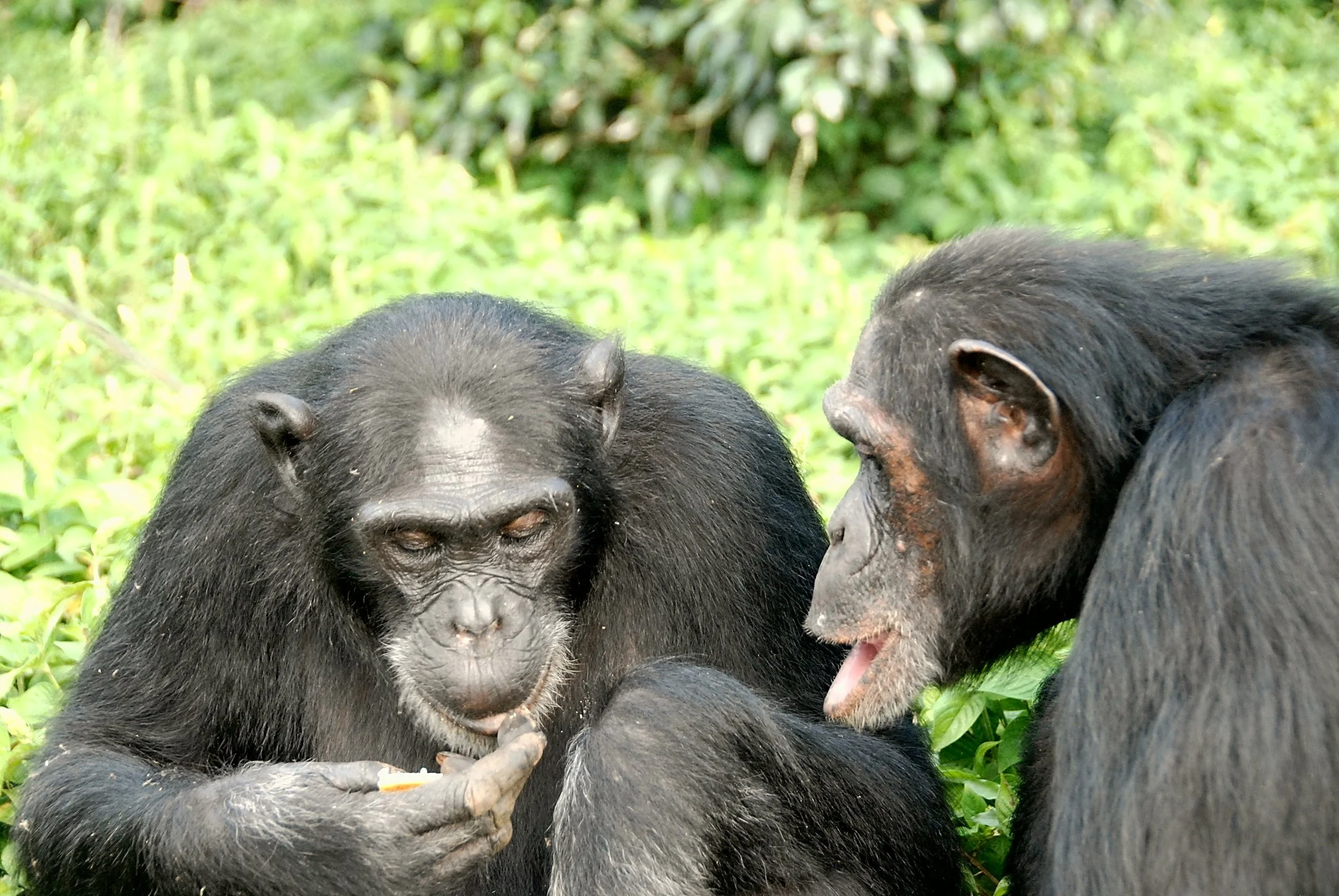
Sometimes the rewards of joint work cannot be divided, and only one partner can benefit at a time. In these situations, children from around five years of age resolve the conflict of interest by taking turns, ensuring that both partners benefit over time and remain motivated to keep cooperating. Chimpanzees, by contrast, do not take turns in this way, and their collaboration tends to break down (Melis et al., 2016).
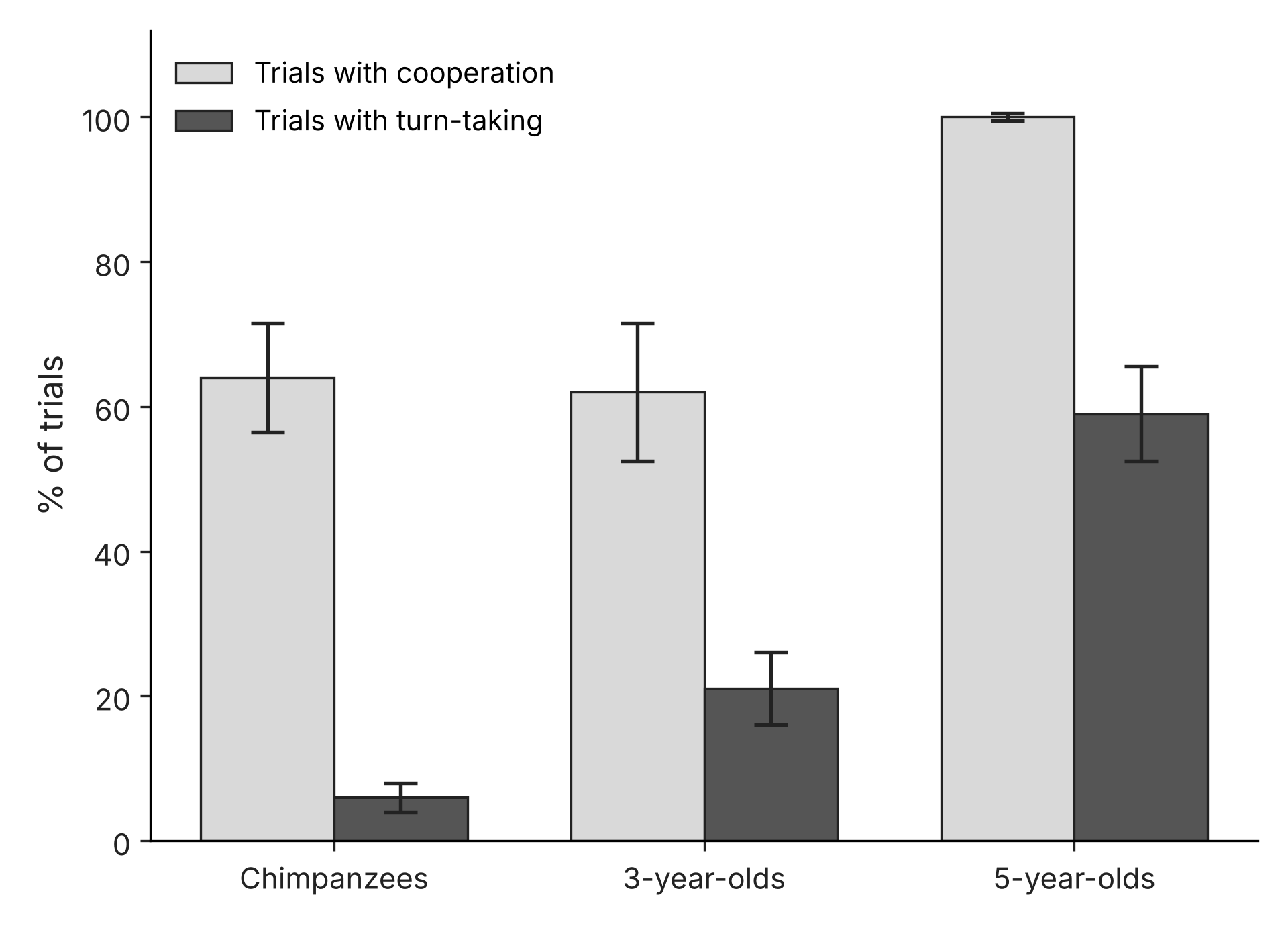
Proportion of trials in which partners cooperated and took turns obtaining the reward, in chimpanzees, 3-year-olds and 5-year-olds (from Melis et al. 2016)