Reciprocity
Humans possess a wide range of strategies to deter cheating, which allow high levels of cooperation to evolve and remain stable among unrelated individuals, even in large groups. One mechanism supporting the long-term stability of prosocial behaviour is direct reciprocity, in which individuals exchange favours across repeated encounters, accepting a short-term cost in return for long-term benefits.
Reciprocity can be based on different mechanisms. In past-driven reciprocity, individuals keep track of previous interactions and preferentially help or share with those who have helped them before. Chimpanzees, for example, help more those who have helped them in the past, suggesting that their reciprocal cooperation may rely on such a past-oriented mechanism (Melis et al., 2008).
A cognitively more demanding form is future-oriented, or strategic, reciprocity, in which individuals help others in anticipation of future returns. This type of reciprocity has been the focus of our CoRe project (see below).
The cognitive foundations of human reciprocity (CoRe)
Co-investigators: Elliot Ludvig (University of Warwick), Felix Warneken (University of Michigan) · Funded by ESRC–NSF
In this project, we investigated what makes it possible to help others now in anticipation of a later return. We focused on three cognitive traits (planning, patience and risk tolerance) and tested chimpanzees, children of different ages and adults on tasks measuring each trait, as well as their willingness to invest in partners who could reciprocate later.
In a study with nearly 300 adults, patience was the most consistent predictor of future-oriented cooperation: more patient individuals invested more in partners who could return the favour (Keupp et al., 2026). Planning and risk tolerance showed less consistent links. Interestingly, people’s choices in different risk tasks did not correlate with one another, and each task related to cooperation in a different way. This suggests that common risk tasks may capture different motives, such as a drive to maximise rewards versus a genuine willingness to take chances, rather than a single, general attitude to risk.
Our studies with chimpanzees showed that they are less risk-seeking than previously thought when a gamble can leave them empty-handed, and that individual risk preferences are remarkably stable across tasks (Keupp et al., 2021a). Unlike in humans, chimpanzees’ patience was unrelated to their risk preferences, suggesting that these decision-making abilities may be linked differently in the two species (Keupp et al., 2021b). Preliminary results from a further study (currently under review) suggest that chimpanzees keep helping a partner who can return the favour later, but help less when reciprocation is not possible, which points to some sensitivity to future opportunities for reciprocity.
More results from our studies with children and chimpanzees are coming soon, so stay tuned!
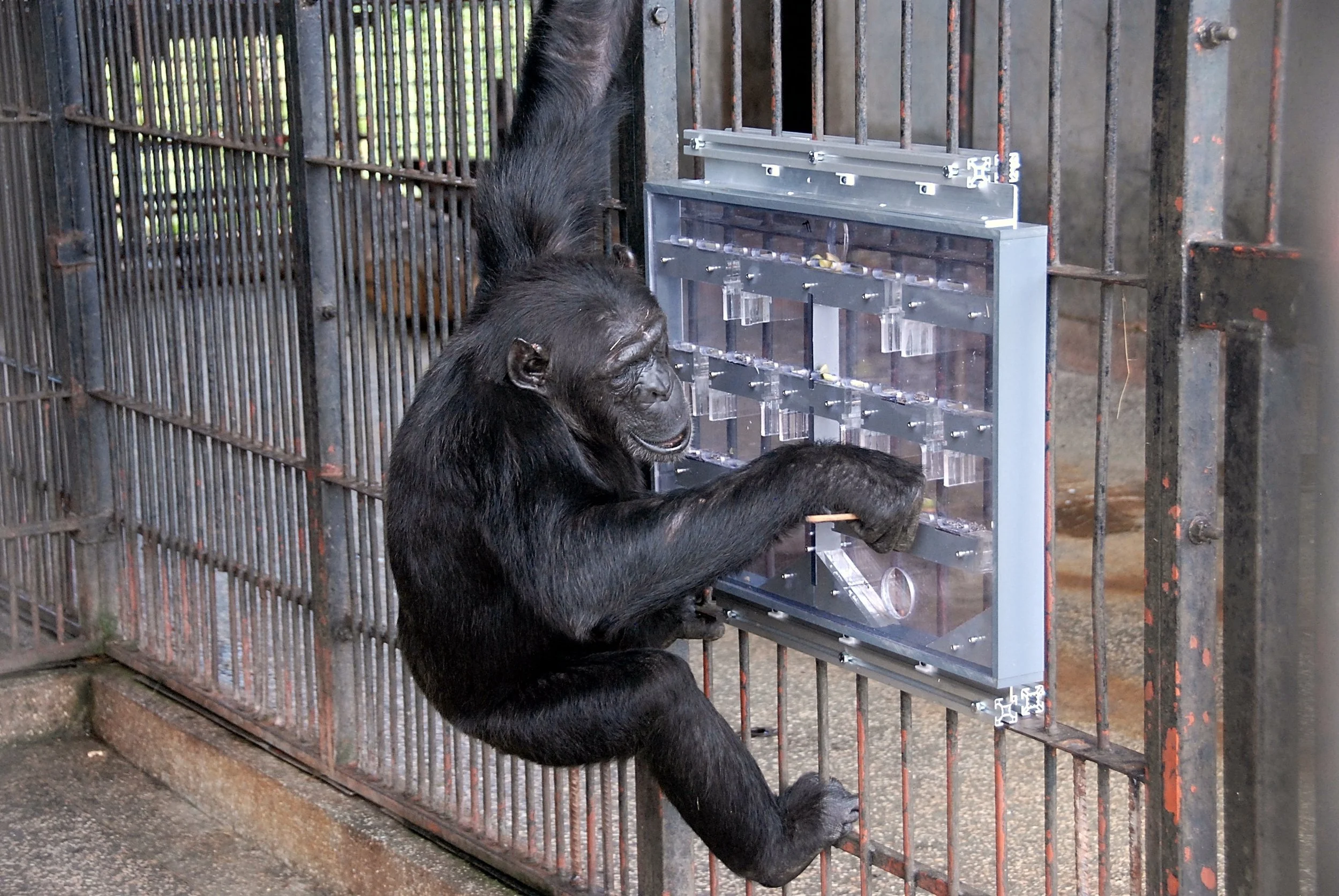
A chimpanzee at Ngamba Island Chimpanzee Sanctuary solving a planning task. Chimpanzees take part voluntarily, in the sleeping enclosures where they come in each evening, and spend their days in the island’s forest.